Everything you Need
To Verify and Control
Pennsylvania Identity
Documents
Our printed I.D. Checking Guides and online versions are used by
DMVs, government agencies at all levels, and businesses.
Check Pennsylvania Drivers Licenses & IDs

Pennsylvania ID Checks Start With Knowing the Real Card
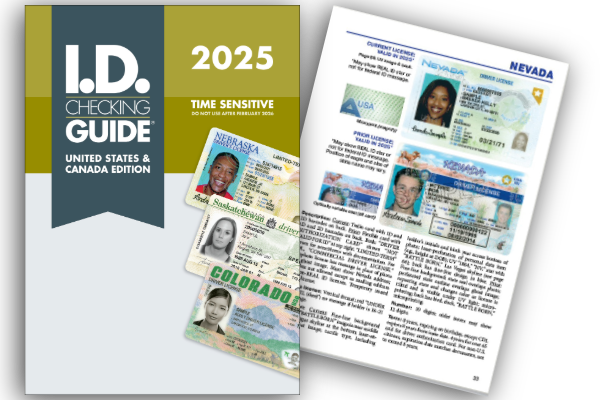
A Pennsylvania bartender, bank teller, or casino host may see a hundred licenses in a single shift. Knowing how to spot a fake Pennsylvania ID starts with a clear picture of what PennDOT actually issues. The I.D. Checking Guide (U.S. & Canada) provides that picture. It reproduces Pennsylvania credentials in true-to-size color and applies the same standard to every U.S. state, U.S. territory, and all Canadian provinces and territories.
Read More
Pennsylvania shares borders with six states and Pittsburgh sees steady traffic from Ohio and West Virginia. On Penn State home game weekends, bars in State College fill up long before kickoff. Casinos are required to keep anyone under 21 off the gaming floor. In each of these settings, staff need a dependable way to confirm the ID corresponds to the person handing it over.
Inside the Guide's State Section
Fake Pennsylvania IDs rarely fail in obvious ways. They fail in small places: a character out of alignment, a missing security layer, text that is a fraction too large. The guide's Pennsylvania section marks those small places so a verifier can check them in seconds.
Verifiers can review the orientation of the card and the exact position of the photo, data fields, and state graphics. They can confirm how many digits a valid license number carries, and read the expiration date against Pennsylvania's issuance pattern. They can locate the ghost image, microprinting, and other security details, and compare them against the documented design.
Pennsylvania issues two versions of its license. A REAL ID carries a gold star in the upper right corner. A standard card is marked "Not for REAL ID Purposes." Both are valid, and the guide shows each one, so staff can recognize either version on sight.
What Fake Pennsylvania IDs Usually Look Like
The borrowed card. An underage student uses a real license that belongs to an older friend or roommate who looks similar. Sometimes the card was reported lost. Because nothing about the card is forged, the physical description and photo are the only reliable points of comparison.
The doctored card. A real Pennsylvania license gets edited. Someone may scrape away a birth year and print a new one, bleach the expiration date, or overwrite key details under a fresh laminate. Edges that lift or peel, uneven ink, and characters that don't match their neighbors are common giveaways.
The manufactured card. These look-alike forgeries are fabricated cards, often ordered online and made from unapproved materials. They commonly show incorrect card flexibility, text that is slightly too tall or too thin, and security graphics that look flat or smudged next to the reference image.
Sectors That Rely on Accurate ID Checks
Law Enforcement and Public Safety
The Pennsylvania Turnpike, I-80, I-81, and I-95 carry drivers from across the Northeast and beyond. Officers at a traffic stop may see a Pennsylvania card one minute and a New Jersey or Ohio card the next. A standard reference helps them confirm what a valid version of each card looks like.
Financial Institutions and Transaction Services
Pennsylvania's large regional banks, community banks, and credit unions open accounts, cash checks, and handle wire transfers based on the ID presented. A careful check helps stop identity fraud at the counter. It can also support confirming work authorization when an ID is part of an employment file.
Alcohol Sales and Hospitality
The Pennsylvania Liquor Control Board runs Fine Wine & Good Spirits stores statewide. Beer distributors, restaurants, and licensed grocery and convenience stores sell alcohol too. The PLCB's voluntary RAMP program trains servers and sellers, and the state's laws take RAMP status into account when violations occur. A consistent ID process gives trained staff the reference they need to apply that training at the register.
Facility Access and Security
Pennsylvania's four operating nuclear power plants, along with utilities and government buildings in Harrisburg, restrict who may enter. Access control staff match each person to a valid ID before issuing a visitor badge or opening a gate.
Alcohol Laws in Brief
Pennsylvania sets a minimum fine of $1,000 for a first sale or gift of alcohol to a minor, and $2,500 for each later offense. The offense is a third-degree misdemeanor. Additional penalties can include jail time, a driver's license suspension, and a permanent criminal record. Penalties may be heavier when IDs were not checked thoroughly, and charges may be reduced for RAMP-certified businesses and trained staff. A documented ID check on every sale supports compliance with these laws. The complete guidelines follow.
How to Spot a Fake Pennsylvania ID in Five Checks
Use this order on every card so nothing gets skipped during a rush.
- Set the card beside the Pennsylvania example in the guide and match the design version
- Verify the license number's digit count and position
- Check the expiration date and look for the REAL ID star or the standard-card marking
- Find the ghost image and microprinting and confirm they match the reference
- Compare the photo and physical description with the person in front of you
Where ID Checks Break Down
Most mistakes happen under pressure. Game days in State College and playoff runs in Philadelphia and Pittsburgh bring crowds that push lines out the door. Seasonal and newly hired staff may have had little training. New Jersey, New York, and Maryland licenses each follow their own design. A reference kept within reach gives every employee the same benchmark, regardless of the crowd.
Alcohol Sales & Service Guidelines for Pennsylvania
- Minimum age to consume: 21 - Minimum age to serve: 18 - Minimum age to bartend: 18 - Server/seller alcohol training required.
A person under 21 may not purchase alcoholic beverages as part of a law enforcement action.
Penalties for serving or selling to a minor: In Pennsylvania, the minimum fine for selling or giving alcohol to a minor is $1,000 for the first offense and $2,500 for each subsequent offense. This is a third-degree misdemeanor under Title 18, § 6310.1 of the Pennsylvania General Assembly. Other penalties may include: Up to one year in jail, Mandatory driver's license suspension, and Permanent criminal record.
Consequences may be less severe if the vendor was deceived, such as by a minor using a fake ID. However, penalties may be more severe if IDs are not checked thoroughly or at all. Criminal charges may also be reduced if the business is RAMP Certified or the employee is RAMP Server/Seller Trained.
There is one exception to the law, which applies if alcohol is given to a minor during a religious ceremony or service in a private home or place of worship. In this case, the amount of wine served must be within the amount that is traditionally required as part of the ceremony or service.


Pennsylvania Fake ID FAQs
Where should I start when checking a Pennsylvania license?
Look at the card design and the expiration date first. Once those check out, examine the security features and compare the photo with the person.
Does RAMP training replace a careful ID check?
No. RAMP training teaches staff what to do. A reference guide gives them something concrete to compare each card against during the check.
What if the customer has a New Jersey or New York license?
Turn to that state's page in the guide before making a decision. Neighboring states use different layouts, numbering, and security features.
What should I do with a license that is peeling or damaged?
Treat damage around the photo, birth date, or expiration date with extra caution. Compare every visible detail against the reference and follow your organization's policy on damaged IDs.
Is a REAL ID required to buy alcohol in Pennsylvania?
No. REAL ID is optional in Pennsylvania, and a standard license remains valid identification. The guide shows both versions so staff can recognize either one.
Equip Your Team With a Proven Reference
Confident ID decisions come from knowing exactly what a valid card looks like. The I.D. Checking Guide (U.S. & Canada) has supported verifiers for more than 50 years. It offers one standardized reference for every U.S. state, U.S. territory, and all Canadian provinces and territories.
Get the I.D. Checking Guide and help your Pennsylvania staff check every ID the same careful way.
How to Spot a Fake Pennsylvania ID
For law enforcement officers, bank tellers, car rental agents, human resources professionals and others who must verify ID in a professional capacity, the recent surge in fake IDs is challenging. The liability and losses that result from accepting a fake ID are large. The I.D. Checking Guide assists in the ID verification process by showing what an actual, valid ID looks like at full-size, and highlights the details of the licenses, making it much easier to spot the fraud. Before approving an expensive car rental, opening a new bank account or hiring a new employee, make sure the driver's license or ID card has the correct numbering, UV, microprint, ghost images, expiration, and other details that counterfeiters often miss.

Markets Served

Financial Services

Alcohol Control

Government

Law Enforcement
What the I.D. Checking Guide Includes:
- A full page or more for each U.S. state and Canadian province, showing driver's licenses and ID cards.
- Security image information for ghost images, laser perforation, microprint, UV and other validation details.
- Explanation of what the proper alphanumeric sequencing of a Pennsylvania ID or Driver's License should be (how many letters, numbers, etc.).
- U.S. Federal documents including immigration, military ID, Visas and passport cards.
- "How to check driver's licenses" techniques for training.