
Everything you Need
To Verify and Control
New York Identity
Documents
Our printed I.D. Checking Guides and online versions are used by
DMVs, government agencies at all levels, and businesses.
Check New York Drivers Licenses & IDs

Addressing Identity Document Fraud Throughout New York State
Spotting a fake New York ID quickly is just as important as confirming a valid one.
Read More
New York's large population, high volume of visitors, and extensive travel connections create a significant need for accurate identity document verification. Frontline workers handle a steady volume of out-of-state and foreign credentials, making rigorous authentication vital to detecting fraudulent credentials.
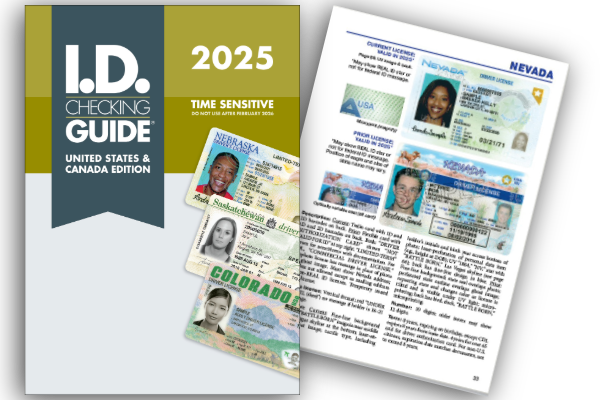
The I.D. Checking Guide (U.S. & Canada) provides a standardized reference to help workers confirm whether an ID is a valid, government-issued original and not a counterfeit copy. For over 50 years, this print and digital publication has provided the specifications needed to verify documents accurately and maintain consistency across shifts.
Establishing a Standard Protocol for ID Verification
Reviewing physical ID credentials requires a systematic process for verifying that each presented document conforms to its applicable standards. But when under pressure, employees may rely on unverified assumptions rather than comparing the card against an established reference.
The I.D. Checking Guide (U.S. & Canada) removes this vulnerability by presenting full-color images of government-issued documents alongside specifications like numbering structure, validity period, data layout, security features, and other identifying characteristics.
Document verifiers use the Guide to examine out-of-state credentials with the same precision they apply to familiar local licenses. Covering every U.S. state and territory, all Canadian provinces and territories, and federal documents from both countries, the Guide helps verifiers identify potentially fraudulent ID cards across jurisdictions.
Key Verification Points for a Fake New York ID
Your team must follow a standard process to verify that a New York license corresponds to the person presenting it, and that it conforms to the official specifications detailed in the Guide. For example on the current New York credential, the holder's ghost image switches with their month and year of birth as the card is tilted.
Personnel use the Guide to:
- Confirm the card uses the correct orientation and data layout.
- Check that the license's term of validity matches the stated expiration policy.
- Verify whether the license is REAL ID-compliant or displays the appropriate non-REAL ID statement.
- Confirm the unique layout of a New York enhanced driver license, which is valid for land or sea re-entry to the U.S. from Canada, Mexico, or the Caribbean.
- Verify license number structure and formatting.
- Check the positioning and appearance of secondary ghost images.
- Confirm security features such as tactile text, ultraviolet ink images, and microprinting.
Common Types of Fraudulent Credentials
Fraudulent identity credentials generally fall into two categories: modifications of genuine cards and completely fabricated imitations. In modified credentials, individuals alter a legitimate document by scraping, bleaching, or overwriting details such as the date of birth or expiration date.
Fabricated cards are produced from unauthorized materials to mimic the appearance of an official state credential. These look-alike forgeries may contain errors in text sizing, card flexibility, or the reproduction of security graphics. Comparing a questionable card directly against a standardized reference can help reveal discrepancies in these physical characteristics.
Credential Verification and Compliance Across These Sectors
Verifiers across multiple sectors must follow standard procedures to ensure consistent, accurate credential checks. Relying on quick, unassisted visual inspections under pressure can increase the risk of errors and inconsistent decisions. A physical reference manual gives staff a consistent basis for evaluating ID credentials.
Law Enforcement
Confirming identity during traffic stops, field patrols, or active investigations is essential to ensure officer safety and protect the public. Law enforcement personnel must quickly assess ID documents to evaluate whether credentials are valid.
Financial Services
Banking centers, credit unions, and check-cashing operations rely on valid identity credentials to support secure customer transactions and reduce fraud. Employees may need to review expiration dates and identifying numbers on credentials during new-hire onboarding.
Alcohol Sales and Hospitality
Bars, lounges, and retail package stores must verify a patron's age before completing an alcohol transaction to comply with state laws. Venues near major universities or high-volume entertainment districts may face increased pressure to verify IDs accurately and consistently.
Facility Access Control
Corporate security personnel rely on photo identification cards to prevent unauthorized access to high-security areas like data centers, power plants, and utility infrastructure. Guards must systematically evaluate credentials against established criteria to help maintain site security and verify access authorization.
Alcohol Sales & Service Guidelines for New York
- Minimum age to consume: 21 with some exceptions - Minimum age to serve: 18 - Minimum age to bartend: 18
A person under 21 may not purchase alcoholic beverages as part of a law enforcement action.
Penalties for serving or selling to a minor: In New York, the penalties for selling or serving alcohol to someone under 21 can vary depending on the individual or business involved:
- Businesses
Can face fines up to $5,000, license suspension, or license revocation. Businesses may also be liable if a minor leaves their establishment after consuming alcohol and causes injury, property damage, or death.
- Bartenders and store clerks
Can face up to one year in jail and a $1,000 fine.
- Parents
Can face up to one year in jail, a $1,000 fine, and civil liability for any property damage, injury, or death caused by the minor's alcohol consumption. Parents also cannot purchase alcohol for their child to consume in a New York State Liquor Authority-licensed bar or restaurant.
- Social hosts
Can face fines of $250–$1,000 and up to one year in jail for knowingly allowing a gathering or event where minors are present, and alcohol is consumed. The first and second offenses are violations of the law, while the third and subsequent offenses are misdemeanors.
Individuals convicted of supplying alcohol to minors may also be placed on probation and required to perform community service or other services.


New York Fake ID FAQs
Which physical features should a verifier check first?
Personnel must evaluate card orientation, expiration validity, and physical description before authenticating security features such as tactile text or microprinting.
What makes New York a target area for look-alike forgeries?
High-volume international transit, dense metropolitan populations, and major entertainment districts create environments where transactions occur at a rapid pace. This constant flow can make it more difficult for staff to scrutinize credentials carefully, increasing the risk that look-alike forgeries may go undetected.
How do verifiers handle unexpected updates to driver's license formats?
State authorities routinely update credential layouts and security features. Verifiers should not assume an unfamiliar card is valid simply because it has a new design. Checking the document against current information in the reference Guide helps verifiers apply the appropriate verification criteria.
Does the guide cover credentials issued outside of New York?
Yes. The publication includes specifications for government-issued ID credentials from every U.S. state, territory, and Canadian province and territory. It also covers federally issued credentials such as passports, visas, and immigration documents.
How does manual verification support business compliance?
Using a physical reference guide helps employees follow a standardized verification process and supports the organization's efforts to exercise due diligence in meeting applicable state and federal requirements.
Strengthen Your Organization's ID Verification Process
Accepting invalid identification documents can expose your organization to legal, financial, and regulatory consequences. A standardized, physical review process helps employees identify potentially fraudulent documents and apply consistent verification procedures.
Equipping your operation with a physical reference reduces guesswork and gives your team a consistent basis for evaluating credentials. The Drivers License Guide has supported ID verification professionals for more than 50 years.
Secure your copy of the I.D. Checking Guide (U.S. & Canada) today to give your team the certainty required to follow state laws.
How to Spot a Fake New York ID
For law enforcement officers, bank tellers, car rental agents, human resources professionals and others who must verify ID in a professional capacity, the recent surge in fake IDs is challenging. The liability and losses that result from accepting a fake ID are large. The I.D. Checking Guide assists in the ID verification process by showing what an actual, valid ID looks like at full-size, and highlights the details of the licenses, making it much easier to spot the fraud. Before approving an expensive car rental, opening a new bank account or hiring a new employee, make sure the driver's license or ID card has the correct numbering, UV, microprint, ghost images, expiration, and other details that counterfeiters often miss.

Markets Served

Financial Services

Alcohol Control

Government

Law Enforcement
What the I.D. Checking Guide Includes:
- A full page or more for each U.S. state and Canadian province, showing driver's licenses and ID cards.
- Security image information for ghost images, laser perforation, microprint, UV and other validation details.
- Explanation of what the proper alphanumeric sequencing of a New York ID or Driver's License should be (how many letters, numbers, etc.).
- U.S. Federal documents including immigration, military ID, Visas and passport cards.
- "How to check driver's licenses" techniques for training.