
Everything you Need
To Verify and Control
New Jersey Identity
Documents
Our printed I.D. Checking Guides and online versions are used by
DMVs, government agencies at all levels, and businesses.
Check New Jersey Drivers Licenses & IDs

ID Verification Challenges Across New Jersey
Spotting a fake New Jersey ID quickly is just as important as confirming a valid one.
Read More
New Jersey's proximity to New York City and Philadelphia, extensive interstate travel, and Atlantic City casino industry create a uniquely demanding identity verification environment. Businesses routinely examine identification from across the U.S. and abroad, making accurate document verification critical to detecting fraudulent credentials.
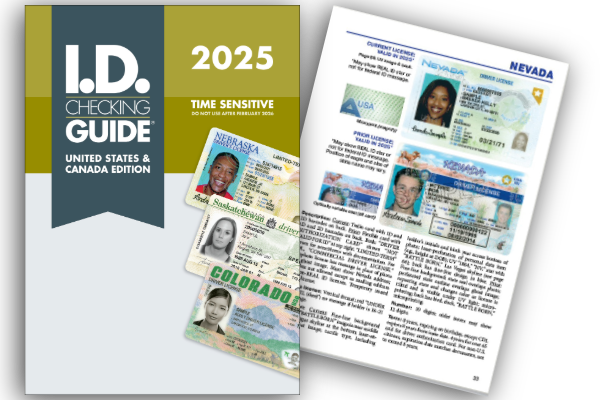
The I.D. Checking Guide (U.S. & Canada) provides a standardized reference for validating identity documents. For more than 50 years, our print and digital publications have supplied reference details on official state, federal, and provincial formats required to confirm that an ID corresponds to the person presenting it. Using this structured resource supports a consistent and repeatable identity verification process across organizations. .
A Standardized Way to Verify IDs
Manual inspection requires a systematic approach to ensure a credential satisfies legal parameters. Employees frequently rely on memory or unverified assumptions when checking documents under pressure. The I.D. Checking Guide (U.S. & Canada) removes the ambiguity of compliance checks by presenting full-color, complete representations of valid government documents.
This publication lists the exact spatial placement of standard formatting elements, text heights, and security items. Verifiers use these clear descriptions to check out-of-state credentials with the same precision as local documents. The resource supplies comprehensive coverage detailing every U.S. state, U.S. territory, and all Canadian provinces and territories to protect operations against cross-border fraud.
Key Details to Check for a Fake New Jersey ID
Verifiers must evaluate specific formatting laws to authenticate a New Jersey credential. When reviewing a document, users should compare the card against the security features listed in the manual.
Your team must follow a strict process to:
- Verify using card orientation, number format, expiration, and physical match.
- Inspect the explicit design configurations mandated for REAL ID credentials.
- Confirm character counts and alphanumeric spacing rules inside the license number field.
- Examine the exact orientation of secondary ghost images and background graphics.
- Match the physical characteristics of the presenter to the printed physical description.
- Analyze embedded production elements including tactile lettering, ultraviolet ink profiles, and microprinting.
Types of Fake IDs to Watch For
Fraudulent documents generally surface as modified genuine cards or completely fabricated imitations. In modified instances, individuals take a valid state card and scrape, bleach, or overwrite details like the date of birth or expiration stamp to bypass local laws.
Fabricated cards, or look-alike forgeries, are made entirely from unapproved materials to resemble the official look of a state layout. These look-alike forgeries typically display minor errors in text sizing, incorrect card flexibility, or poorly executed security graphics. Comparing a questionable card directly against a standardized reference manual reveals these formatting errors immediately.
Compliance Enforcement Across These Sectors
Verifiers across multiple commercial and regulatory sectors must execute standardized checking procedures to maintain strict compliance. Depending solely on unassisted visual checks under pressure creates unnecessary liability risks during daily operations. Utilizing an objective document manual allows personnel to protect their organizations by maintaining consistent, accurate security checks across every department.
Law Enforcement
Verifying identity during roadside stops, field patrols, or active criminal investigations remains a vital protocol for maintaining officer safety and protecting the general public. Officers must rapidly evaluate structural card formatting to confirm vehicle operator data and enforce state traffic laws.
Financial Services
Banking locations, credit unions, and dedicated check-cashing storefronts rely on authenticated credentials to protect teller workflows and secure consumer transactions against fraud. Representatives must review license number sequences and expiration stamps to stop financial identity fraud. Tellers also verify official document markings to confirm work authorization during the onboarding process.
Alcohol Sales and Hospitality
Taverns, restaurants, and package stores must verify a customer's age before finalizing an alcohol transaction to prove compliance with training standards and avoid civil litigation or liquor license suspension. Establishments situated near the Jersey Shore or major college campuses use standardized references to reduce the risk of underage service.
Facility Access Control
Private security details rely on photo identification cards to bar unauthorized entry into critical facilities like corporate data centers, nuclear power plants, and utilities infrastructure. Guard details must systematically verify every credential against an official standard to ensure overall site security and confirm access authorization.
Alcohol Sales & Service Guidelines for New Jersey
- Minimum age to consume: 21 - Minimum age to serve: 18 - Minimum age to bartend: 18
A person under 21 may not purchase alcoholic beverages as part of a law enforcement action.
Penalties for serving or selling to a minor: In New Jersey, selling or serving alcohol to someone under 21 is a disorderly person’s offense. Penalties for a conviction include:
- Up to $1,000 fine
- Up to 6 months in prison
- Criminal record
- Probation
- Other monetary penalties, such as a Victims of Crime Compensation Board penalty or a Law Enforcement Officers Training and Equipment Fund penalty
- Participation in an alcohol education or treatment program
In addition, the Division of ABC or municipal ABC Board may also seek to suspend the business's liquor license and force it to close. The length of the suspension depends on the number of previous offenses associated with the license.


New Jersey Fake ID FAQs
Which physical features should a verifier check first?
Personnel must examine the overall card orientation, expiration validity, and the physical description before verifying embedded security features such as microprinting.
What makes New Jersey a target area for look-alike forgeries?
High-density commuter networks, large universities, and high-volume entertainment districts create environments where fast transactions occur. This allows individuals to attempt fraud using look-alike forgeries.
How do verifiers handle unexpected updates to driver's license formats?
State jurisdictions periodically modify document designs by introducing new layouts, character placements, and security elements. Verifiers must not guess or assume a credential is valid simply because a design is unfamiliar. Comparing the unknown card format against the verified updates in the reference manual ensures immediate compliance with current state laws.
How does manual verification support business compliance?
By using a physical reference guide, employees maintain a standardized process that proves the business acts with due diligence to uphold state laws.
Does the manual outline credentials issued outside of New Jersey?
Yes. The publication includes exact specifications for every U.S. state, U.S. territory, and all Canadian provinces and territories.
Help Your Team Verify IDs Accurately
Accepting invalid identification credentials exposes your organization to severe legal liabilities, financial losses, and administrative actions. Implementing a standardized, physical review procedure protects your team from deceptive documents.
Equipping your business with a physical reference system removes guesswork and establishes operational control. Drivers License Guide has set the industry standard for fraud prevention and document compliance for over five decades.
Secure your copy of the I.D. Checking Guide (U.S. & Canada) today to give your team the absolute certainty required to follow state laws.
How to Spot a Fake New Jersey ID
For law enforcement officers, bank tellers, car rental agents, human resources professionals and others who must verify ID in a professional capacity, the recent surge in fake IDs is challenging. The liability and losses that result from accepting a fake ID are large. The I.D. Checking Guide assists in the ID verification process by showing what an actual, valid ID looks like at full-size, and highlights the details of the licenses, making it much easier to spot the fraud. Before approving an expensive car rental, opening a new bank account or hiring a new employee, make sure the driver's license or ID card has the correct numbering, UV, microprint, ghost images, expiration, and other details that counterfeiters often miss.

Markets Served

Financial Services

Alcohol Control

Government

Law Enforcement
What the I.D. Checking Guide Includes:
- A full page or more for each U.S. state and Canadian province, showing driver's licenses and ID cards.
- Security image information for ghost images, laser perforation, microprint, UV and other validation details.
- Explanation of what the proper alphanumeric sequencing of a New Jersey ID or Driver's License should be (how many letters, numbers, etc.).
- U.S. Federal documents including immigration, military ID, Visas and passport cards.
- "How to check driver's licenses" techniques for training.