
Everything you Need
To Verify and Control
New Hampshire Identity
Documents
Our printed I.D. Checking Guides and online versions are used by
DMVs, government agencies at all levels, and businesses.
Check New Hampshire Drivers Licenses & IDs

ID Verification Challenges Across New Hampshire
Spotting a fake New Hampshire ID quickly is just as important as confirming a valid one.
Read More
New Hampshire presents specific identity verification challenges for businesses and enforcement personnel. Border retail traffic from neighboring states increases the circulation of out-of-state credentials every day. College towns and winter tourist destinations also create high-volume verification environments. Verifiers must perform accurate document checks to protect operations and remain compliant with state laws.
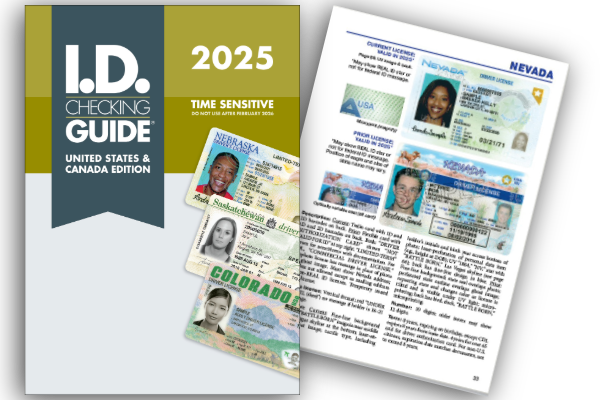
The I.D. Checking Guide (U.S. & Canada) provides a direct solution by letting your team compare any presented license against official document standards. For more than 50 years, this guide has delivered reliable information to help verifiers confirm that an ID corresponds to the person presenting it. Using a standardized reference guide ensures consistent checking procedures across your entire organization.
A Standardized Way to Verify IDs
Fast-paced retail or security settings can make manual verification difficult. Employees frequently rely on memory or unverified assumptions when checking documents. The I.D. Checking Guide (U.S. & Canada) offers a clear, mechanical reference to check credentials with certainty.
Each document entry shows a life-size, full-color image of a valid credential. Detailed reference notes explain exactly how the document should appear under official guidelines. This text includes standard license layouts, correct character counts, date placements, and visible security elements.
Because New Hampshire businesses interact with visitors from across the continent, the guide includes complete listings for every U.S. state, U.S. territory, and all Canadian provinces and territories.
Key Details to Check for a Fake New Hampshire ID
Verifiers must evaluate specific formatting rules to authenticate a New Hampshire credential. When reviewing a document, users should compare the card against the security features listed in the manual.
Your team must follow a strict process to:
- Verify using card orientation, number format, expiration, and physical match.
- Confirm official REAL ID indicators and correct symbol placement.
- Inspect the license number structure for proper character spacing.
- Check the exact positioning of the issue and expiration dates.
- Match the physical characteristics of the presenter to the physical description printed on the card.
- Examine embedded security details, including ghost images, ultraviolet elements, and microprinting.
Types of Fake IDs to Watch For
Invalid credentials found in New Hampshire generally belong to two primary categories. The first category involves authentic licenses that individuals alter after issuance. Fraudsters physically modify birth years, adjust expiration dates, or change the printed physical description to bypass local laws.
The second category includes look-alike forgeries created from scratch to mimic real state layout designs. While these look-alike forgeries may look correct during a brief glance, they routinely fail direct comparison tests. They often feature incorrect font sizes, wrong line spacing, or misaligned security features. Checking these cards against a standardized template reveals these flaws immediately.
Industries That Use the Guide
Law Enforcement
During traffic stops, patrols, or investigations, confirming identity is critical for the safety of officers and the public. Personnel must evaluate credentials quickly and look for exact formatting matches under state laws.
Financial Services
Banks, credit unions, and check cashing operations depend on valid IDs to support teller services and secure transactions. Verifiers must review license numbers and expiration formats to mitigate financial fraud. Tellers must also check valid documentation to confirm work authorization during new account onboarding.
Alcohol Sales and Hospitality
Bars, restaurants, and stores must confirm age before selling alcohol to demonstrate their training efforts and avoid potential litigation or license suspension. New Hampshire ski resorts, hospitality venues, and college towns face elevated compliance risks.
Facility Access Control
Security teams rely on photo ID to restrict access to sensitive sites like data centers, government facilities, and utility infrastructure. Personnel must verify credentials against standardized templates to ensure site security and confirm access authorization.
Alcohol Sales & Service Guidelines for New Hampshire
- Minimum age to consume: 21 - Minimum age to serve: 18 - Minimum age to bartend: 18
Alcohol retailers have the statutory right to sue a minor who uses a false ID to purchase alcohol for any losses or fines suffered by the retailer as a result of the illegal sale.
A person under 21 may not purchase alcoholic beverages as part of a law enforcement action.
Penalties for serving or selling to a minor: In New Hampshire, the penalty for selling or serving alcohol to a minor can vary depending on the circumstances:
- Supplying alcohol to a minor: A criminal offense that can result in a $2,000 fine and up to a year in jail. This includes parents or other relatives who provide alcohol to underage people.
- Hosting a party where minors drink alcohol: A misdemeanor that can result in a $2,000 fine and up to a year in jail.
- Prohibited sales: A Class B misdemeanor that can result in a $1,200 fine.
- Businesses with liquor licenses: May face administrative actions that can result in additional fines, license suspension, or license revocation.
Other penalties that may be imposed include probation, community service, or mandatory alcohol education classes.


New Hampshire Fake ID FAQs
Why does New Hampshire require strict ID verification procedures?
Tax-free retail shopping and seasonal outdoor tourism draw thousands of out-of-state visitors daily. This high volume increases local exposure to look-alike forgeries and altered credentials.
What should a verifier review first on a New Hampshire ID?
A verifier must examine the card orientation, expiration date formatting, and the physical characteristics of the presenter before conducting a detailed review of embedded security icons.
Does the guide contain information for non-resident credentials?
Yes. The guide covers valid layout formats and security designs for every U.S. state, U.S. territory, and all Canadian provinces and territories.
How does the guide help protect a business from liability?
It provides an objective, manual reference that demonstrates a business is following standard verification procedures to enforce state laws.
Empower Your Team to Verify IDs Accurately
Accepting an invalid identification card can result in severe financial penalties, operational disruptions, and licensing issues. Implementing a standard verification protocol protects your staff and your business.
For more than 50 years, Drivers License Guide has provided the precise reference tools needed to maintain compliance and stop identity fraud.
Order the I.D. Checking Guide (U.S. & Canada) today to ensure your team can verify credentials with complete certainty.
How to Spot a Fake New Hampshire ID
For law enforcement officers, bank tellers, car rental agents, human resources professionals and others who must verify ID in a professional capacity, the recent surge in fake IDs is challenging. The liability and losses that result from accepting a fake ID are large. The I.D. Checking Guide assists in the ID verification process by showing what an actual, valid ID looks like at full-size, and highlights the details of the licenses, making it much easier to spot the fraud. Before approving an expensive car rental, opening a new bank account or hiring a new employee, make sure the driver's license or ID card has the correct numbering, UV, microprint, ghost images, expiration, and other details that counterfeiters often miss.

Markets Served

Financial Services

Alcohol Control

Government

Law Enforcement
What the I.D. Checking Guide Includes:
- A full page or more for each U.S. state and Canadian province, showing driver's licenses and ID cards.
- Security image information for ghost images, laser perforation, microprint, UV and other validation details.
- Explanation of what the proper alphanumeric sequencing of a New Hampshire ID or Driver's License should be (how many letters, numbers, etc.).
- U.S. Federal documents including immigration, military ID, Visas and passport cards.
- "How to check driver's licenses" techniques for training.