Everything you Need
To Verify and Control
Nevada Identity
Documents
Our printed I.D. Checking Guides and online versions are used by
DMVs, government agencies at all levels, and businesses.
Check Nevada Drivers Licenses & IDs

ID Verification Challenges Across Nevada
Spotting a fake Nevada ID quickly is just as important as confirming a valid one. Nevada presents unique identification verification challenges due to its tourism industry and large entertainment sector. In cities like Las Vegas and Reno, businesses and security teams may review hundreds of IDs during a single shift. Casinos, bars, nightclubs, retailers, hotels, and financial institutions all depend on accurate identification checks to help reduce fraud and maintain compliance with Nevada laws.
Read More
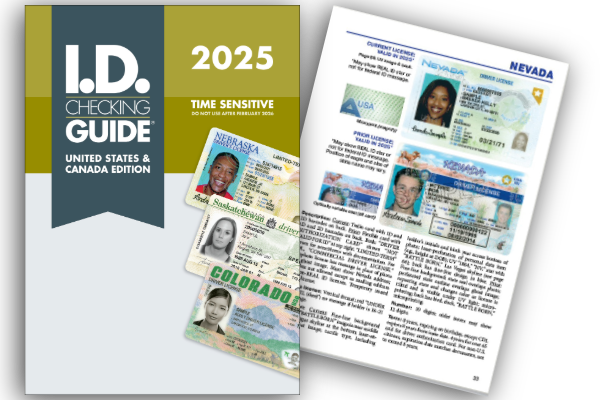
The I.D. Checking Guide (U.S. & Canada) provides a dependable way to compare identification documents against official standards. By using a trusted reference, professionals can confirm that an ID aligns with Nevada-issued formats and corresponds to the individual presenting it. This supports safer transactions, stronger compliance practices, and more consistent verification procedures. By using a trusted reference, professionals can confirm that an ID matches the format issued by the corresponding state
Nevada's hospitality and gaming industries create especially high exposure to invalid or misused IDs. Whether someone attempts to bypass age restrictions, gain access to restricted gaming areas, or complete a fraudulent transaction, accepting an invalid credential can create serious operational and legal consequences.
A Reliable Way to Verify IDs
Fast-paced environments can make ID verification difficult, especially when employees rely only on memory or limited experience. The I.D. Checking Guide (U.S. & Canada) provides clear, side-by-side references for Nevada driver's licenses and identification cards so users can compare credentials with greater accuracy.
Each ID is shown in life-size, full color, with detailed reference notes explaining how legitimate credentials are structured. This includes license layout, numbering format, date placement, and embedded security features that help distinguish valid identification from altered or imitation credentials.
Because Nevada businesses regularly encounter visitors from across the country, the Guide also includes references for every U.S. state, U.S. territory, and all Canadian provinces and territories. This helps users evaluate out-of-state IDs presented in casinos, hotels, retail stores, entertainment venues, and hospitality environments.
Key Details to Check on a Nevada Driver's License
Nevada driver's licenses and ID cards contain specific formatting and security details that can be verified through direct comparison. When reviewing a Nevada ID, users can confirm:
- Horizontal or vertical orientation
- REAL ID indicators and placement
- License number structure and formatting
- Placement of issue and expiration dates
- Physical characteristics
- Expected card design and layout
- Security elements such as holographic overlays, ultraviolet features, ghost images, and microprinting
Careful comparison against verified examples helps users identify inconsistencies that may not be obvious during a quick visual review.
Recognizing Invalid or Misused IDs
Invalid Nevada IDs typically fall into two categories. The first involves authentic credentials that have been altered after issuance. This may include modified birth dates, adjusted expiration details, or changes to identifying information.
The second category involves imitation credentials designed to resemble legitimate Nevada IDs. While these may appear convincing at first glance, they often contain inconsistencies involving formatting, spacing, physical characteristics, or embedded security features.
A reference-based verification process helps users identify differences between legitimate Nevada credentials and IDs that do not meet official standards.
Where Accurate ID Verification Matters Most
Across Nevada, many industries depend on consistent ID verification procedures as part of daily operations.
Gaming and Casino Operations
Nevada's gaming industry relies heavily on identification checks. Security teams, casino staff, and gaming personnel may review IDs during age verification, financial transactions, restricted access procedures, and patron identification processes.
Hospitality and Alcohol Sales
Hotels, bars, restaurants, nightclubs, and convenience stores must verify age before completing alcohol sales. Careful ID checks help businesses support compliance with Nevada laws and reduce liability risks tied to underage sales.
Law Enforcement
Officers conducting patrols, investigations, and traffic stops must confirm identification quickly and accurately. Reliable reference materials help support informed decision-making during field contacts and enforcement activity.
Financial Services
Banks, casinos, and financial institutions rely on valid identification documents during transactions, account verification, and fraud prevention procedures. Consistent ID verification practices help protect both businesses and customers.
Facility Access Control
Security personnel at data centers, utilities infrastructure, healthcare facilities, and restricted properties use photo identification to confirm access authorization and support site security procedures.
Alcohol Sales & Service Guidelines for Nevada
- Minimum age to consume: 21 - Minimum age to serve: 21 - Minimum age to bartend: 21 - Server/seller alcohol training required.
A person under 21 may not purchase alcoholic beverages as part of a law enforcement action.
Penalties for serving or selling to a minor: In Nevada, knowingly selling or giving alcohol to a minor is a misdemeanor offense. Penalties for a first offense can include: Up to $1,000 in fines, up to six months in jail, and Community service.
Penalties for a second or subsequent offense can be even more severe, including: Fines of up to $2,000 and up to one year in jail.
Businesses that have liquor licenses may also face administrative actions, such as additional fines, license suspension, or license revocation.
If you sell or give alcohol online, you must adopt a policy that includes:
- Requiring a signature from someone who is 21 or over for anyone delivering alcohol
- Clearly marking all packages shipped that contain alcohol
If you fail to adopt an appropriate policy, you could be charged with a misdemeanor criminal offense and fined up to $500.


Why Consistent Fake ID Verification Procedures Matter in Nevada
Businesses that rely on quick visual reviews alone may miss important inconsistencies during transactions. A structured verification process helps employees review identification documents more consistently under pressure.
Verification should include:
- Card orientation
- Expiration format
- License number formatting
- Physical characteristics
- Visible security features
- Overall physical match between the presenter and the ID
Using a trusted reference guide helps employees follow the same verification process across locations and shifts.
Nevada Fake ID FAQs
Why is Nevada considered a high-risk state for fake IDs?
Nevada's tourism, casino, nightlife, and hospitality industries create frequent ID verification situations. High transaction volume increases exposure to invalid or misused IDs.
What should users review first on a Nevada ID?
Users should begin by reviewing overall card layout, orientation, expiration validity, and physical characteristics before comparing security features and formatting details.
Can the I.D. Checking Guide help with out-of-state IDs used in Nevada?
Yes. The Guide includes references for every U.S. state, U.S. territory, and all Canadian provinces and territories, making it useful in environments where visitors frequently present non-Nevada identification.
How does the Guide support casino and hospitality operations?
The Guide helps employees compare identification documents against verified formats and security features during age verification, gaming access checks, and financial transactions.
What types of businesses benefit from ID verification tools in Nevada?
Casinos, bars, hotels, retailers, financial institutions, law enforcement, and security teams all benefit from reliable ID verification reference materials.
Support More Accurate ID Verification
Invalid identification documents can create compliance issues, operational disruptions, financial losses, and safety concerns. Consistent verification procedures help reduce those risks.
For more than 50 years, Drivers License Guide has provided trusted reference materials used by professionals across law enforcement, hospitality, gaming, retail, financial services, and security operations.
Order the I.D. Checking Guide (U.S. & Canada) today to help your team verify IDs accurately, reduce fraud exposure, and operate with greater confidence under Nevada laws.
How to Spot a Fake Nevada ID
For law enforcement officers, bank tellers, car rental agents, human resources professionals and others who must verify ID in a professional capacity, the recent surge in fake IDs is challenging. The liability and losses that result from accepting a fake ID are large. The I.D. Checking Guide assists in the ID verification process by showing what an actual, valid ID looks like at full-size, and highlights the details of the licenses, making it much easier to spot the fraud. Before approving an expensive car rental, opening a new bank account or hiring a new employee, make sure the driver's license or ID card has the correct numbering, UV, microprint, ghost images, expiration, and other details that counterfeiters often miss.

Markets Served

Financial Services

Alcohol Control

Government

Law Enforcement
What the I.D. Checking Guide Includes:
- A full page or more for each U.S. state and Canadian province, showing driver's licenses and ID cards.
- Security image information for ghost images, laser perforation, microprint, UV and other validation details.
- Explanation of what the proper alphanumeric sequencing of a Nevada ID or Driver's License should be (how many letters, numbers, etc.).
- U.S. Federal documents including immigration, military ID, Visas and passport cards.
- "How to check driver's licenses" techniques for training.