
Everything you Need
To Verify and Control
Connecticut Identity
Documents
Our printed I.D. Checking Guides and online versions are used by
DMVs, government agencies at all levels, and businesses.
Check Connecticut Drivers Licenses & IDs

The Importance of ID Verification in Connecticut
In Connecticut, verifying identification isn't just a routine step—it's a vital safeguard. Businesses, agencies, and institutions across the state rely on accurate ID checks to stay compliant, protect public safety, and prevent fraud. That's where the I.D. Checking Guide comes in—a trusted resource used across Connecticut to help professionals confidently verify IDs from all 50 states, Canada, and beyond.
Read More
From Hartford nightclubs and casinos to New Haven dispensaries and Fairfield County banks, the risk of accepting a fake ID carries serious consequences. Whether the goal is to enforce age-restricted laws, deter financial fraud, or confirm work eligibility, having a reliable way to evaluate identification is essential.
How the I.D. Checking Guide Supports Professionals in Connecticut
Modern fake IDs can appear convincing. But when compared side by side with images of verified samples and validated details in the I.D. Checking Guide, even well-made forgeries may be exposed. The Guide helps professionals:
- Visually compare real and suspect IDs.
- Understand card orientation and expiration dates.
- Spot missing or altered security features.
- Check key elements like license number format, photo placement, and UV markings.
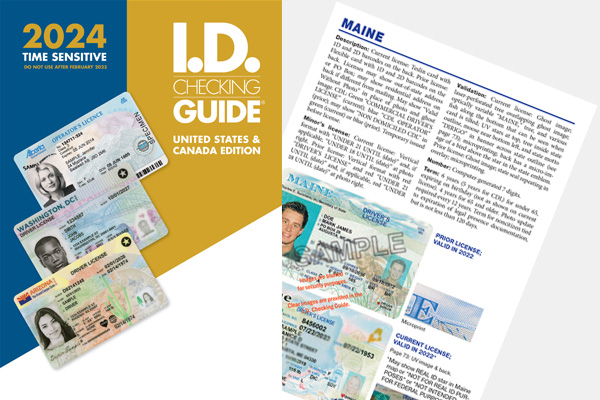
By including actual-size images, detailed descriptions, and highlighted security features, the Guide enables fast, accurate ID verification—without relying on scanning technology or barcodes.
Who Uses the I.D. Checking Guide in Connecticut?
Many sectors in Connecticut depend on accurate ID checks to reduce liability, prevent fraud, and comply with state and federal laws:
Law Enforcement
Police departments and campus security use the Guide during stops, investigations, and access control situations to confirm identity in real time.
Financial Institutions
Banks and credit unions rely on the Guide to verify customers' identities and prevent fraud when opening accounts or issuing credit.
Retail, Hospitality, and Cannabis
Restaurants, bars, liquor stores, and dispensaries use the Guide to avoid costly penalties for serving underage patrons or accepting invalid identification.
Government Agencies
Organizations managing public benefits, licensing, or background checks depend on visual ID verification to maintain secure operations.
Human Resources and Employers
HR departments use the Guide to confirm work authorization and ensure ID accuracy during onboarding and employment verification.
What the Guide Helps You Verify
The I.D. Checking Guide gives users the tools to confidently assess a wide range of ID elements:
- Minor's License Indicators: Orientation (usually vertical), date formatting, and the presence of "Under 18/21" indicators
- Description: Physical characteristics and appearance of the license, including variations among cards of the same format
- Security Features: Microprinting, ghost images, UV-sensitive ink, and holograms
- License Number Format: Character count, sequencing, and spacing specific to Connecticut
- Expiration Term: Validity periods after issuance or renewal
- Out-of-State Samples: Real ID examples from all 50 states and 10 Canadian provinces, as well as their respective territories, for comparison
These features help Connecticut professionals validate IDs not only from within the state, but also from nearby border regions and tourist destinations.
Common Types of Fake IDs and How to Detect Them
The I.D. Checking Guide equips users to recognize several types of deceptive documents:
- Borrowed or Altered IDs: IDs that have been modified or used by someone other than the legal holder. Check for mismatched photos, altered birthdates, or scratched laminate.
- Look-Alike Forgeries: Fake IDs that closely imitate real ones but lack security features like UV ink, raised text, or correct formatting.
- Manufactured Fakes: Illegitimate cards designed from scratch to mimic official credentials, often failing under close inspection.
By cross-referencing ID features against the Guide, users can quickly detect inconsistencies and make informed decisions.
Alcohol Sales & Service Guidelines for Connecticut
-Minimum age to consume: 21 with some exceptions -Minimum age to serve: 18 -Minimum age to bartend: 18
A person under 21 may purchase alcoholic beverages as part of a law enforcement action.
Penalties for serving or selling to a minor: Connecticut has multiple laws that prohibit selling or serving alcohol to minors, and the penalties vary depending on the circumstances:
- Selling or delivering liquor to a minor
A permittee or their agent can face up to one year in prison, a fine of up to $1,000, or both for selling or delivering liquor to a minor, unless it's under a doctor's orders. This includes internet sales. Anyone else who gives or delivers liquor to a minor can face up to 18 months in prison, a fine of up to $1,500, or both.
- Allowing minors to possess alcohol
Allowing minors to possess alcohol or host underage drinking parties can result in a $146 fine for a first offense, and up to one year in prison and/or a fine of up to $500 for subsequent offenses.
- Allowing minors to loiter on premises
Permittees or their employees can't allow minors to loiter on premises where liquor is kept for sale or served at a bar.
- Serving alcohol without valid ID
It's illegal to serve alcohol to anyone without a valid form of photo ID that shows they're 21 or older.
- Serving alcohol to someone who's visibly intoxicated
It's illegal to serve alcohol to anyone who's already visibly intoxicated.


FAQs About Spotting Fake Connecticut IDs
Why is ID verification important in Connecticut?
In Connecticut, verifying identification is essential for staying compliant with state and federal laws, protecting public safety, and preventing fraud. From nightclubs and casinos to banks and dispensaries, accepting a fake ID can lead to serious legal and financial consequences.
How does the I.D. Checking Guide help detect fake IDs?
The I.D. Checking Guide provides actual-size images, detailed descriptions, and highlighted security features of valid IDs from all 50 states and Canada. It enables professionals to visually compare suspect IDs, check license number formats, and spot missing security features like UV markings and microprinting.
Who uses the I.D. Checking Guide in Connecticut?
The Guide is used by law enforcement, financial institutions, retail and hospitality businesses, cannabis dispensaries, government agencies, and HR departments. Any professional who needs to verify identification for compliance, fraud prevention, or security purposes can benefit from the Guide.
What types of fake IDs can the Guide help identify?
The Guide helps users recognize borrowed or altered IDs, look-alike forgeries that lack proper security features, and manufactured fakes designed to mimic official credentials. By cross-referencing ID features against verified samples, users can quickly detect inconsistencies.
What ID features does the Guide help verify?
The Guide helps verify minor's license indicators (vertical orientation, 'Under 18/21' markers), security features (microprinting, ghost images, UV ink, holograms), license number format, expiration terms, and provides out-of-state samples from all 50 states and Canadian provinces for comparison.
How to Spot a Fake Connecticut ID
For law enforcement officers, bank tellers, car rental agents, human resources professionals and others who must verify ID in a professional capacity, the recent surge in fake IDs is challenging. The liability and losses that result from accepting a fake ID are large. The I.D. Checking Guide assists in the ID verification process by showing what an actual, valid ID looks like at full-size, and highlights the details of the licenses, making it much easier to spot the fraud. Before approving an expensive car rental, opening a new bank account or hiring a new employee, make sure the driver’s license or ID card has the correct numbering, UV, microprint, ghost images, expiration, and other details that counterfeiters often miss.

Markets Served

Financial Services

Alcohol Control

Government

Law Enforcement
What the I.D. Checking Guide Includes:
- A full page or more for each U.S. state and Canadian province, showing driver’s licenses and ID cards.
- Security image information for ghost images, laser perforation, microprint, UV and other validation details.
- Explanation of what the proper alphanumeric sequencing of a Connecticut ID or Driver’s License should be (how many letters, numbers, etc.).
- U.S. Federal documents including immigration, military ID, Visas and passport cards.
- “How to check driver’s licenses” techniques for training.